News | September 27, 2023

INTERVIEW. 2012 24H BARCELONA. McLaren wins! 

Adam Christodoulou on the McLaren 12C GT3’s first 24-hour win with Lapidus Racing at the 2012 24H BARCELONA.
share this content on:

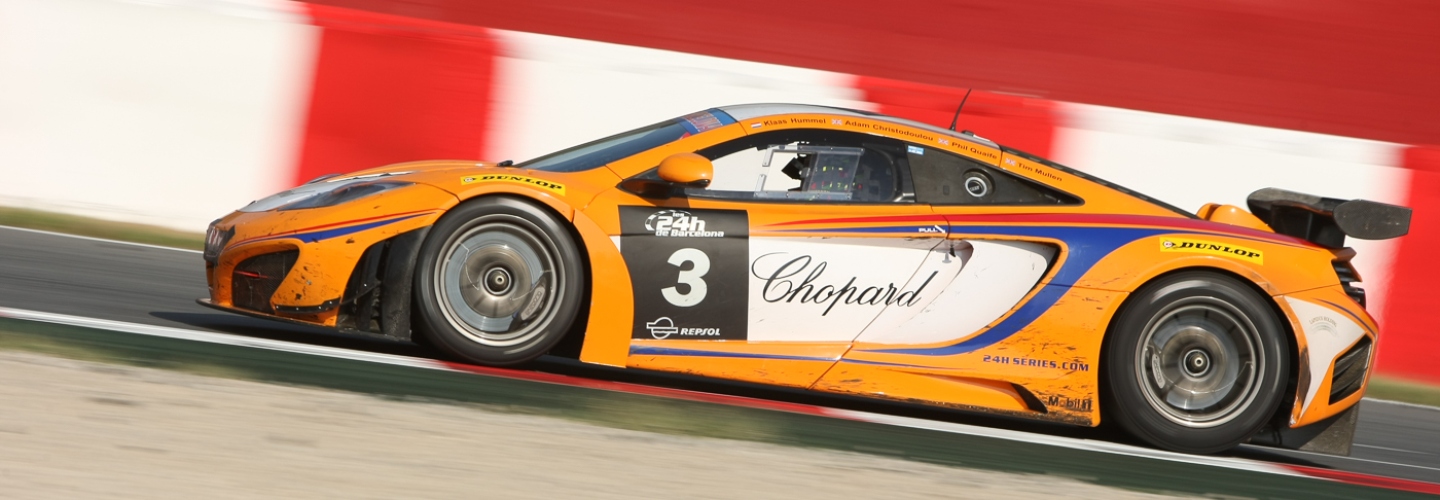
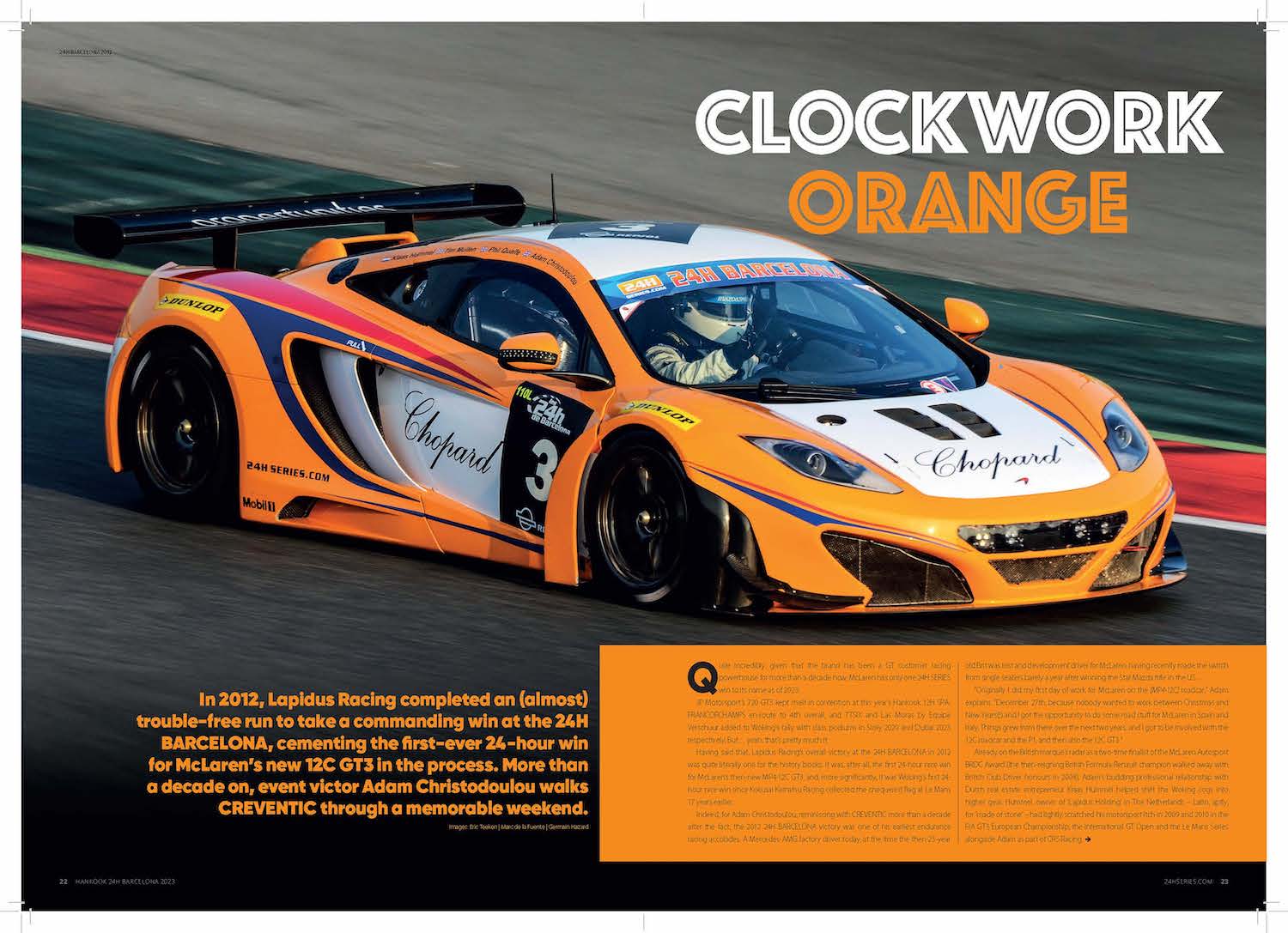
In 2012, Lapidus Racing completed an (almost) trouble-free run to take a commanding win at the 24H BARCELONA, cementing the first-ever 24-hour win for McLaren’s new 12C GT3 in the process. More than a decade on, event victor Adam Christodoulou walks CREVENTIC through a memorable weekend.  


Words – James Gent

Images – Eric Teeken / Germain Hazard / Marc de la Fuente / Ryan Savage

Quite incredibly, given that the brand has been a GT customer racing powerhouse for more than a decade now, McLaren has only one 24H SERIES win to its name as of 2023.


JP Motorsport’s 720 GT3 kept itself in contention at this year’s Hankook 12H SPA-FRANCORCHAMPS en-route to 4th overall, and 7TSIX and Las Moras by Equipe Verschuur added to Woking’s tally with class podiums in Sicily 2020 and Dubai 2023 respectively. But… yeah, that’s pretty much it. 


Having said that, Lapidus Racing’s overall victory at the 24H BARCELONA in 2012 was quite literally one for the history books. It was, after all, the first 24-hour race win for McLaren’s then-new MP4-12C GT3, and, more significantly, it was Woking’s first 24-hour race win since Kokusai Kaihatsu Racing collected the chequered flag at Le Mans 17 years earlier.


Indeed, for Adam Christodoulou, reminiscing with CREVENTIC more than a decade after the fact, the 2012 24H BARCELONA victory was one of his earliest endurance racing accolades. A Mercedes-AMG factory driver today, at the time the then-23-year old Brit was test and development driver for McLaren, having recently made the switch from single seaters barely a year after winning the Star Mazda title in the US…


“Originally I did my first day of work for McLaren on the [MP4-12C] roadcar,” Adam explains. “December 27th, because nobody wanted to work between Christmas and New Years(!) and I got the opportunity to do some road stuff for McLaren in Spain and Italy. Things grew from there over the next two years, and I got to be involved with the 12C roadcar and the P1, and then also the 12C GT3.”

Already on the British marque’s radar as a two-time finalist of the McLaren Autosport BRDC Award (the then-reigning British Formula Renault champion walked away with British Club Driver honours in 2008), Adam’s budding professional relationship with Dutch real estate entrepreneur Klaas Hummel helped shift the Woking cogs into higher gear. Hummel, owner of ‘Lapidus Holding’ in The Netherlands – Latin, aptly, for ‘made of stone’ – had lightly scratched his motorsport itch in 2009 and 2010 in the FIA GT3 European Championship, the International GT Open and the Le Mans Series alongside Adam as part of CRS Racing. 


“I’d ended up being given the opportunity to do the final two races [of 2010, in the International GT Open] with CRS Racing,” Adam continues, “because Chris Niarchos wasn’t able to do them. That’s how I met Klaas. Through the winter, we had a few discussions and ended up racing together for the next three years. 


“The first year, we raced a Ferrari [F430] GT2 in the European Le Mans Series through CRS. The season after that, they’d ended up with the contract to develop the new 12C with McLaren. And as we happened to be racing with them, we’d been given the opportunity to do one or two tests. ‘Lapidus’ was one of the first customers. In fact, we had the very first chassis – 001 – and ended up doing a full season with it, including Barcelona.”


Come 2012, Klaas was ready to oversee his own team, ‘Lapidus Racing’, with McLaren’s new GT3 flagship as its centrepiece and Adam quickly signed up as the boss’ PRO teammate.


“That year we decided to create our own team, and that’s where ‘Lapidus Racing’ came from. Even though I wasn’t involved in the management, I got to experience how much time and effort and stress goes into creating a team! It was a real eye-opener.”

Barely five months after “breaking cover,” and after a pole-setting British GT Championship debut in July, three ‘McLaren GT’, twin-turbo V8-powered 12C GT3s were entered for the 2011 Spa 24 Hours, with McLaren development driver Adam leading the Von Ryan Racing/McLaren GT collaborative line-up. Despite its demonstrative pace however, all three 12C’s hit trouble at Spa – the #59 was involved in a huge accident during McLaren GT project manager Andrew Kirkaldy’s stint, and the #58 caught fire later on – with only Von Ryan’s entry reaching the chequered flag.


“We went as, basically, a factory team as part of the deal for the development of the car, with one or two McLaren engineers with us. Two of the cars ended up retiring through damage, four or maybe six hours into the race. And so that meant, suddenly, there was a lot of pressure doing the Spa 24 Hours: ‘we NEED to finish, this is our goal.’ It didn’t go as smooth sailing as we’d hoped” – the #60 VonRyan entry suffered bodywork damage early on during an on-track collision – “and I can’t remember exactly where we finished – I want to say 11th or 12th in-class – but we had a strong run.


On Lapidus Racing’s 24-hour race debut at the following year’s Spa 24 Hours, luck once again was not in Woking’s favour, and Adam’s 12C GT3 was one of seven not to make the finish. Approaching its second 24-hour race two months later in September 2012 then – the 24H BARCELONA – Lapidus’ game plan was simple: just get to the finish. A prospect, as it turns out, made all the more difficult by unexpectedly high temperatures.


“We had the air conditioning kits on the helmets, but back then they weren’t so reliable. So, yeah, I remember it being incredibly tough.


“In fact, it was so hot that, during testing, our main engineer ended up with heat stroke. We had to take it in turns during the rest of the weekend to make sure he stayed hydrated, and we got him a big sun hat to wear! So it wasn’t just the drivers that were suffering.”

Despite the heat and the McLaren’s tribulations in the Ardennes, Lapidus’ hopes of a strong weekend were vindicated when McLaren Automotive test driver Phil Quaife, who’d also raced alongside Adam and Klaas at CRS Racing and at Spa, set a blistering 1m 54.501s laptime during Free Practice. A massive two and a half seconds faster than any other team. 


Amazingly, Tim Mullen, the final member of Lapidus Racing’s line-up (and another CRS alumnus), went even quicker during Night Practice, the Briton’s 1m 54.107s a more combative 2.7 seconds quicker than the Dutch team’s nearest rival.


“I’d done a lot of testing in the UK and abroad, and done a 30-hour test before McLaren went racing in 2011 with the 12C GT3. So I already knew the car inside-out, and had probably done more test miles than the average driver would do during a full season.


“The car was really quick, super racy. It was interesting actually, bouncing between the [Ferrari] GT2 and the [McLaren] GT3 in 2011. I remember jumping back into the Ferrari at one event, and coming into the pits immediately saying, ‘guys, there’s something wrong with the engine.’ I guess the power of the turbos gave the McLaren a real punch!”


As expected, the #3 Lapidus Racing 12C was at the sharp end for most of Friday’s two-hour qualifying session. But with temperatures dropping dramatically in the closing 15 minutes, bragging rights eventually went to the #4 Ferrari 458 GT3 of Russian Bears Motorsport, much to the delight of polesitter Maurizio Mediani, the sole Italian on a grid of 220-plus drivers, in the only Ferrari entered for the event. Focusing instead on race setup, Lapidus’ Free Practice rocket ship was pushed back to the second row on the grid, outpaced as it was in the closing stages by not just the Russian Bears’ prancing horse, but also the Renault Mégane Trophy – of all things! – of SP2 polesitter, Las Moras Racing Team.


“Ah, yes, but that was a tubular frame chassis and had a crazy amount of power!


“Also, qualifying is great because the outright performance is there, but for a 24-hour race in particular, it’s more about driver combination and reliability. And, okay, we didn’t stick it on the front row, but I think we were quietly confident that we had one of the strongest line-ups there that weekend. The only question mark we had was whether the McLaren could handle the heat for 24 hours.”

Strategic pace in qualifying notwithstanding, Lapidus Racing was quickly on the move when the green flag fell on Saturday 8 September. With Phil Quaife behind the wheel for the first stint, the McLaren easily dispatched the Las Moras Mégane down the start-finish straight, and was already harrying the pole-sitting Ferrari through turn one.


The Russian Bears’ advantage was short-lived as Quaife was soon up alongside, and past, the #4 Ferrari down the main straight, and proceeded to disappear into the distance. After 31 laps, the McLaren was 11 seconds ahead of the Ferrari, with 3rd-placed Las Moras now 95 seconds behind and 4th-placed Car Collection already a lap down. 


And thus the McLaren’s lead grew. After three hours, Adam, Klaas, Quaife and Mullen were already two laps ahead of the Russian Bears, and after six, Lapidus Racing was six laps clear of the rapid but frugal Las Moras Renault, which had leapfrogged the Ferrari. By half-distance, the #3 McLaren 12C GT3 was 11 laps – just over 20 minutes – ahead of everyone else.


That the two A6-class frontrunners were steaming away from the rest of the field was not overly surprising: while the McLaren and the Ferrari were capable of lapping the 4.655km Catalunya circuit in 1m 51s, no other team ducked beneath 1m 55s during the first two hours. On top of that, with the Russian Bears Ferrari unable to punish its tyres in the oppressive Catalan heat, Mediani’s 1m 51.495s fastest lap – already four-tenths slower than Quaife’s 1m 51.092s best – soon stuck out as an outlier as the grip-less Ferrari started falling away. In contrast, the “next evolution” McLaren was running like clockwork. 


“I remember we had a lead but I didn’t remember it being that big. But, again, this was like the new generation of GT3 cars at this point, and I think it was the McLaren that kickstarted the evolution of GT3 cars. BMW came out with the ‘batmobile’ soon after, and one-by-one, all the brands started coming with more and more advanced cars. The McLaren was at the front of that, and obviously the carbon fibre MonoCell meant the 12C was extremely rigid.”


The Russian Bears’ earlier traction problems meant 2nd place at half-distance was now being held by 997 class leader, ARC Bratislava. Five laps further back, SP2 class leader Bonk Motorsport was running 3rd, steering issues having cost the Las Moras Renault seven laps in the pits. The Russian Bears Ferrari meanwhile was now 20 laps adrift of the Lapidus McLaren in 4th place, just ahead, ironically, of its sister SEAT Leon Supercopa. 

Lapidus’ dominant run to that point, however – there can be no other word for it… – was stymied when Mullen, complaining of intermittent power loss over the radio, brought the McLaren into the garage shortly before midnight…


“Suddenly you go from having a nice lead to coming in to repair a turbocharger. We had started to lose pace, and I guess the big concern was, ‘is it going to get worse?,’ and ‘is it going to do more damage and put more load on the other turbo?’ In the end, that’s why we made the decision to change the turbo.” 


Almost 40 minutes were spent replacing the turbocharger, flipping an 11-lap lead into a seven-lap deficit to new outright leader, ARC Bratislava. 


“As a team, we decided, ‘let’s get back out there, push things as hard as we can, and try to claw back on to the podium.’ ”


Incredibly, the McLaren, now with Adam at the tiller, returned to the track four laps ahead of the Russian Bears Ferrari (tyre degradation and handling issues had struck hard) and still comfortably in the overall top five. A concept that future Nürburgring 24 Hours winner Adam agrees would be unthinkable in today’s endurance racing landscape…


“Yeah, absolutely! Nowadays, if you lose four or five laps, you can’t get those back, just because everything is so much more advanced and so much more reliable. Nowadays, we have certain software that helps us decide our strategies. There’s still a lot for the engineers to do of course, but back then, everything had to be calculated and worked out on the spot. 


“Also, with the cars, it’s incredible now! Realistically, there could be four or five cars finishing on the lead lap! Like the Nürburgring 24 Hours that we won in 2016. We won that by six seconds. After 24 hours! Last year, we finished 2nd at the Nürburgring, and we missed out by, I think, 17 or 18 seconds. So it just shows you how much closer and how much more competitive everything has become now. 


“These endurance races aren’t endurance races anymore. They’re 24-hour sprints!”

Unfathomably – by today’s standards, at least – the #3 McLaren, at times lapping six seconds faster than either the ARC Bratislava Porsche or the Bonk Motorsport Corvette, was back up to 2nd just three hours after its turbocharger failure. By hour 17, aided by ARC Bratislava being handed a five-lap penalty for a yellow flag infringement, Lapidus Racing was back in the lead, and one hour after that, Adam, Klaas, Quaife and Mullen had pulled two laps clear. 


In an attempt to not make life too easy for itself, Lapidus Racing suffered brief contact with 4PET by Las Moras shortly before sun-up when the BMW 123D inadvertently cut across the McLaren’s bows (see sidebar). Fortunately the damage was mostly cosmetic, and the #3 12C GT3 was untroubled thereafter to the chequered flag, with Adam, Klaas, Quaife and Mullen – each with memories of the McLaren’s issues at its previous 24-hour race ringing in their ears – playing it very safe during their final stints. In the end, Klaas Hummel crossed the finish line ‘only’ four laps ahead of the recovering Russian Bears Ferrari 458 GT3 – the bit having been put back between its teeth during the night – and ‘just’ three further laps clear of the ARC Bratislava Porsche.  


“Every win is special, especially a 24-hour win, because they don’t come along that often. Off the top of my head, I think I can name the majority of them, with Barcelona one of the first. 


“It’s funny, after 24 hours, you’re mentally and physically exhausted, and there is suddenly a big release when you do win one of them. Your body almost shuts down because of the adrenaline. Obviously the lack of sleep does finish you off, and you need a few days to recover.”

Though most of McLaren’s headlines, ironically, focused instead on Lewis Hamilton’s win at the Italian Grand Prix – also being held that weekend – Lapidus Racing had, nevertheless made motor racing history in Barcelona. Standing on the top step, Adam Christodoulou, Klaas Hummel, Phil Quaife and Tim Mullen had helped open a brand-new chapter for McLaren’s MP4-12C GT3, a model that would go on to claim three championships, 51 wins and 71 further podiums before its replacement, the 650S GT3, arrived in 2014.


The 2012 24H BARCELONA would also prove a fitting swansong, minus one final GT Open event later that month in Monza, for both Adam and Lapidus Racing’s time with McLaren…


“I remember us looking at options for the year after, and I remember Klaas actually giving me the opportunity to start a brand-new team in the UK with the McLaren. In the end, we worked out that the most expensive way to go racing was to have one car doing one championship! After that we took the decision to go with Mercedes and Black Falcon, and do the Blancpain championship instead in 2013 with Steve Jans. Then in 2016, I signed with Mercedes, which was a huge milestone in my career.  


“But we had a great season in 2012 and we made it into the history books with the 24H BARCELONA win. We can be proud of that.”

You can also check out this article in our 2023 Hankook 24H BARCELONA paddock magazine, available for digital download below.


share this content on: