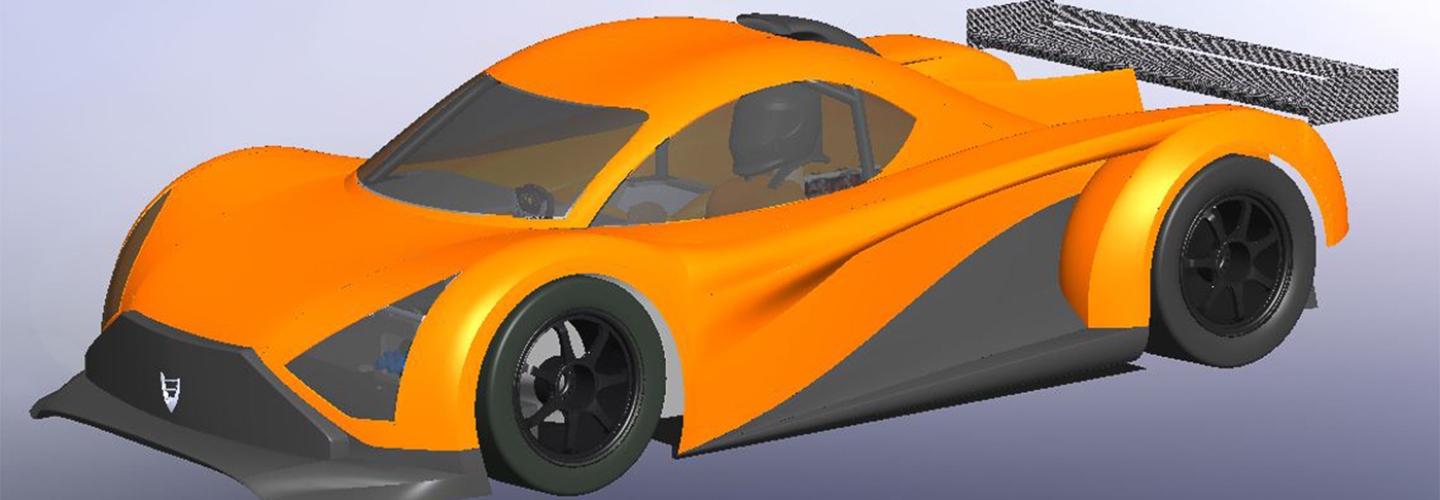
Bonnel, who both competes as a driver with Vortex V8 and oversees the team’s PR and marketing, explained that while the Chevrolet-sourced 6.2-litre V8 will continue to power the new Vortex, significant attention has been paid to the bodywork. Built atop a new carbon chassis, the bodywork, while similar to the 1.0 at the front, will be much sleeker at the rear in an effort to significantly reduce drag. As well as being structurally more rigid and aerodynamic, the new 2.0 will also be both longer and wider than the car it replaces.
“Aerodynamics was a bit priority,” Bonnel continues. “With the [1.0], we have trouble in a straight-line and are limited with our speed. But we are very quick in the corners because there is a lot of downforce. So, the main objective is to keep the downforce the same, but now without that affecting the speed on the straights.
“This means the aero will be completely different. A lot of study has gone into that, and we were actually inspired by the Renault R.S. 01. That also means we can change the position of the driver’s seat too: today [in the 1.0], it’s very straight, and in the new car, it will be more [horizontal].
“For the carbon chassis, there are two reasons. First, it’s much more rigid and stable. And the second one is because it’s a technical improvement, which should make the [lifespan] of the car much greater. By the end of October, we’re aiming to have our first two frames built in carbon.”
Discussions are also ongoing with PKM regarding upgraded suspension for the 2.0.